

Stanford University's Institute for Human-Centered Artificial Intelligence (HAI) released its 2026 AI Index Report this week — a 423-page, data-driven audit of where artificial intelligence actually stands. No marketing hype. No vendor spin. Just numbers.
And the numbers tell two stories simultaneously: AI capability is accelerating faster than predicted, and the systems we're building to measure, govern, and trust it aren't keeping pace. Read more in our AI agents news hub.
AI Agents: The Biggest Jump in the Report
The headline number for anyone building or using AI agents: task success on OSWorld — a benchmark that tests AI agents on real computer tasks across operating systems — jumped from roughly 12% to 66.3%.
That puts agents within 6 percentage points of human performance on structured computer tasks. A year ago, agents could barely navigate a spreadsheet. Now they're approaching human-level competency at software navigation.
But there's a crucial caveat. That 66.3% means agents still fail approximately one-third of the time on structured benchmarks. In unstructured, real-world environments, the failure rate is higher. For business workflows where consistency matters — processing invoices, qualifying leads, handling customer tickets — a 34% failure rate isn't acceptable without human oversight.
This is precisely why the distinction between "AI assistants" and "AI agents built for business" matters. Consumer AI assistants like ChatGPT and Gemini are optimized for general-purpose interaction. Purpose-built business agents — like those on Arahi AI — are designed with guardrails, memory, and tool integrations that dramatically reduce failure rates on specific, repeatable workflows.
What GPT-5.4's OSWorld Score Actually Means
OpenAI's GPT-5.4 reportedly achieved a 75.0% success rate on the OSWorld-Verified benchmark — compared to a 72.4% average human baseline. If confirmed by independent evaluation, this would mark the first time a general-purpose AI outperformed average humans at navigating software environments.
But Stanford's report urges caution. Benchmark scores can be gamed, test sets can overlap with training data, and real-world performance rarely matches lab results. The report notes that many popular benchmarks have error rates of 20–40%, and that AI companies are sharing less about how their models are trained.
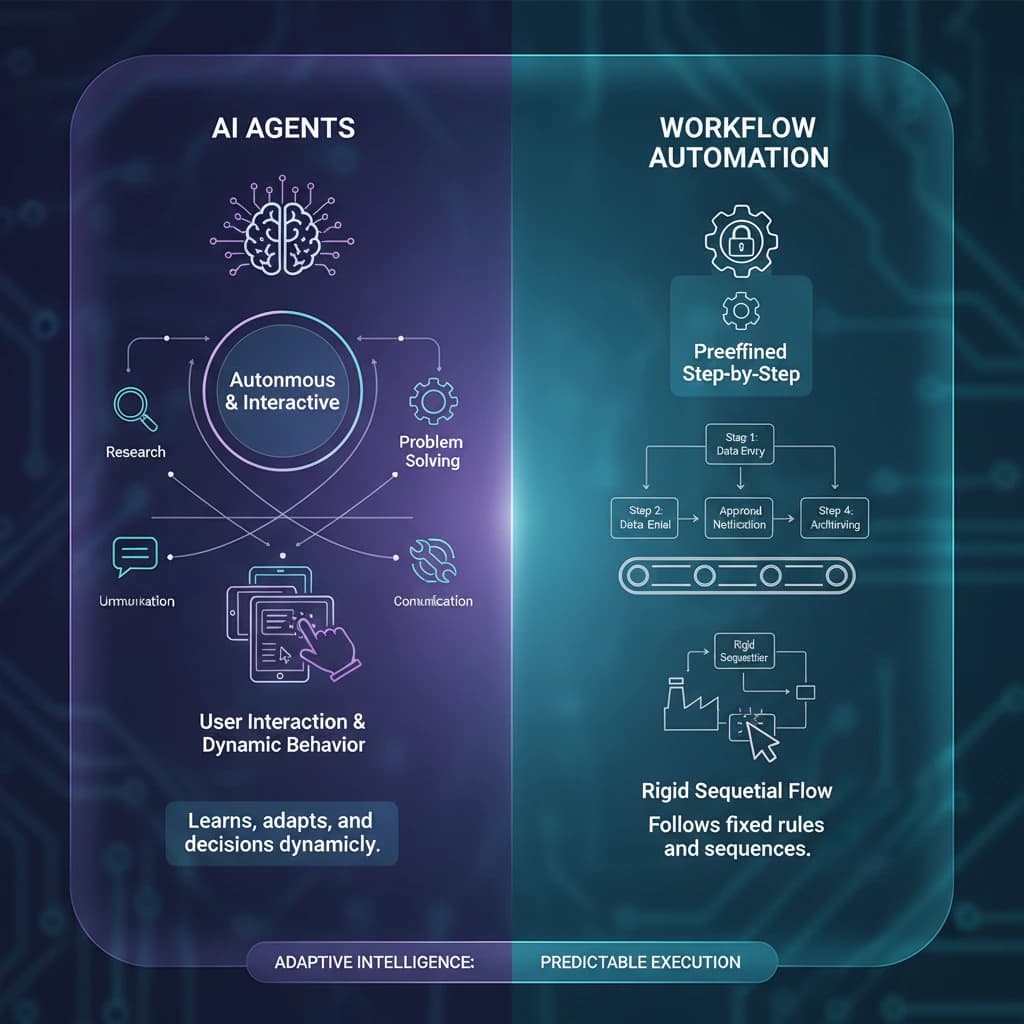
What this means for your workflow: AI agents are now genuinely useful for structured, repeatable software tasks. But reliability still depends on how the agent is deployed. Agents working within defined workflows — with specific tools, clear data sources, and human escalation paths — will dramatically outperform agents given open-ended instructions. This is the architecture Arahi AI uses: agents with built-in memory, native integrations, and workflow-specific logic that reduces the error margin. If you're planning how to introduce agents into a company-wide stack, start with our enterprise workflow automation strategy guide for 2026.
Coding: From 60% to Nearly 100% in One Year
On SWE-bench Verified — a benchmark where AI models must resolve real GitHub issues — performance jumped from 60% to nearly 100% in a single year. This isn't answering quiz questions. This is reading bug reports, understanding codebases, and shipping fixes.
The frontier models now match or exceed human baselines on PhD-level science questions, competition mathematics, and multimodal reasoning. The trajectory mirrors what we covered in AI timelines compressing toward AGI. Google's Gemini Deep Think earned a gold medal at the International Mathematical Olympiad. Anthropic's Claude Opus 4.6 leads the Arena Elo rankings as of March 2026, followed closely by xAI, Google, and OpenAI.
But the "jagged frontier" is real. The same top-performing model that solves Olympiad-level math reads an analog clock correctly just 50.1% of the time — barely better than a coin flip. Headline benchmarks are a poor proxy for real-world reliability.
Adoption Is Universal — But Value Is Not
Stanford's data confirms what enterprise surveys have been showing all year: AI adoption is essentially universal. 88% of organizations report regular AI use in at least one business function, up from 78% a year ago. Generative AI reached 53% of the population faster than either the personal computer or the internet.
But adoption doesn't equal value. The report documents productivity gains of 14–26% in customer support and software development, and up to 72% in marketing teams. For tasks requiring more judgment, the effects are weaker — or even negative.
And here's the most telling data point: AI agent deployment across business functions remains in single digits in nearly every department. Companies have adopted AI for chat, search, and content generation. But autonomous agents that reason, decide, and execute multi-step workflows? That's still early days for most enterprises.
The gap between "using AI" and "deploying AI agents" is where the next wave of business value will come from. The organizations that move from ChatGPT-in-a-browser to connected, autonomous agents running 24/7 across their business tools will be the ones that see real ROI.
The US-China Race Is Closer Than You Think
The geopolitical story in this year's report is the narrowing performance gap between US and Chinese AI models. DeepSeek-R1 briefly matched the top US model in February 2025. As of March 2026, Anthropic's leading model holds just a 2.7% edge over the best Chinese model on Stanford's basket of benchmarks.
The strengths are split. The US still produces more top-tier models and leads in private AI investment ($285.9 billion in 2025 — 23 times China's figure). China leads in publication volume, citations, patent output, and industrial robot installations. South Korea leads in AI patents per capita.
However, the number of AI researchers moving to the US has dropped 89% since 2017 — a significant talent pipeline concern.
Safety and Trust Are Falling Behind
Perhaps the most concerning findings in the report involve safety and public trust:
- Documented AI incidents rose from 233 to 362 in a single year
- Improving one responsible AI dimension (such as safety) can degrade another (such as accuracy)
- Nearly all frontier AI developers report capability benchmarks, but responsible AI benchmark reporting remains inconsistent
- Among surveyed countries, the US reports the lowest public trust in its own government to regulate AI — just 31%
- The EU is trusted more than either the US or China to regulate AI effectively
For business leaders, the safety data reinforces an important principle: deploying AI agents without governance isn't just risky — it's increasingly measurable as risky. Our take on AI agent governance and the resilience mandate goes deeper. The organizations that build trust architecture into their agent systems from day one will have a structural advantage.
The Jobs Picture: Complex and Uneven
Stanford's data on employment is nuanced. AI-related roles are growing — LinkedIn data shows 1.3 million new AI-related roles globally, with 6 million projected for 2026. But in software development, where AI's productivity impact is clearest, employment among US developers aged 22–25 dropped nearly 20% since 2024.
The pattern: AI boosts productivity for experienced workers while reducing demand for entry-level roles. This is happening faster in software development and customer support, and more slowly in fields requiring physical presence, judgment, or relationship management.
Five Takeaways for Business Leaders
1. Agent capability is real — but reliability depends on architecture. The jump from 12% to 66% task success is massive, but the remaining 34% failure rate means agents need defined workflows, not open-ended prompts.
2. The adoption gap is your opportunity. 88% of organizations use AI, but agent deployment is in single digits. Early movers in business automation will compound their advantage.
3. Benchmarks ≠ business value. A model that scores 100% on SWE-bench might fail at your specific workflow. Focus on agents that integrate with your actual tools and data.
4. Governance isn't optional. With AI incidents rising 55% year-over-year, building compliance and oversight into your agent architecture is a business requirement, not a nice-to-have.
5. Start specific, not ambitious. The Stanford data shows the biggest productivity gains come from focused deployments — customer support, code review, data analysis — not company-wide AI transformations.
What This Means for Business Automation
The Stanford AI Index 2026 confirms what practitioners have been experiencing: AI agents are ready for production — but only when deployed with the right architecture.
Consumer AI assistants excel at answering questions and generating content. But the Stanford data shows that real business value comes from agents that:
- Connect to your actual business tools (CRM, email, Slack, spreadsheets)
- Run autonomously with defined workflows and clear escalation paths
- Maintain memory and context across interactions
- Operate 24/7 without requiring human prompting
This is exactly what Arahi AI is built for. While the Stanford report shows AI agents improving rapidly on general benchmarks, Arahi's approach focuses on reliability within specific business workflows — connecting to 1,500+ apps, deploying in minutes with no code, and maintaining the consistency that benchmark scores don't capture.
The theme of 2026 is clear: AI capability is no longer the bottleneck. The bottleneck is deployment architecture — and the organizations that solve it first win.
Put the Stanford findings to work
Arahi AI turns benchmark progress into business outcomes — production-grade agents across 1,500+ apps, deployed in minutes with no code.
Start 7-Day Free TrialRelated: AI Timelines Compressing Toward AGI · Agentic AI Becomes Infrastructure · AI Agent Governance: Critical Resilience Mandate · Google DeepMind Self-Improving AI Agent · AI Agents News