

Last Updated: April 15, 2026
Workflow automation used to be a quiet corner of enterprise software. In 2026, it's one of the loudest. Every iPaaS vendor is shipping AI agents, every RPA incumbent is scrambling to reposition, and every enterprise buyer is trying to figure out what's hype and what's actually worth buying.
This page is our attempt to keep a running pulse on the category. We update it monthly. Each refresh surfaces 12 to 15 news items from the prior 30 days — product launches, funding rounds, analyst reports, regulation updates, and notable case studies — with short analysis of what each one actually means for buyers. No press-release regurgitation; just the signal worth tracking.
April 2026 was a busy month. AI agents crossed what most of us have been waiting for — the "boring" threshold, where every major vendor ships them and they stop being a differentiator and start being a checklist item. Funding announcements kept pace. And the EU AI Act's first real enforcement window closed, forcing a wave of compliance posturing (and, in some cases, real change) across platforms serving European customers.
Last Updated: April 15, 2026
This month's update added four new product announcements, two funding rounds, the Gartner iPaaS Magic Quadrant summary, and the latest on EU AI Act enforcement. We also refreshed the market-size table (2026 projection revised slightly upward) and added a "What buyers should do this quarter" checklist based on conversations with automation leads at a handful of mid-market customers. Next scheduled refresh: May 15, 2026.
Top 3 Themes in April 2026
Before the news items, here's the macro picture. If you read only one section, read this one.
AI agents crossed the chasm
Through 2024 and most of 2025, AI agents in workflow automation felt like a demo category — impressive in a keynote, fragile in production. That changed over the last two quarters. What used to be "we added an AI step to our workflow" is now "our workflow is an agent, and steps are the things the agent calls."
Every major vendor has now shipped an agent builder. Zapier Agents is GA. Microsoft has Copilot-branded agents integrated directly into Power Automate. Make's parent company pushed a generative workflow feature that composes scenarios from a prompt. n8n added native agent nodes. UiPath launched an agent builder targeted at RPA users who want to layer judgment on top of existing bots. When everyone ships the same capability in the same quarter, the capability becomes table stakes.
The practical consequence: buyer RFPs have changed. Where 2024 RFPs asked "do you have an AI step?" 2026 RFPs ask "how do your agents handle multi-step tool use, memory, guardrails, and escalation?" That's a much harder question, and the vendors who have been building in that direction for two years are now pulling away.
Category funding hit $2.1B in Q1
Crunchbase and PitchBook aggregate data puts Q1 2026 workflow-automation venture funding at roughly $2.1B across the top ~15 rounds. That's a step-change from the $900M–$1.1B quarters we saw through most of 2024. The money is flowing almost entirely to AI-native automation startups — Gartner began tracking these as a separate category last year — while legacy iPaaS vendors are largely past their fundraising phase and focused on profitability or strategic M&A.
Two patterns worth naming. First: vertical specialization is getting funded. Healthcare-specific, legal-specific, and finance-specific automation platforms are pulling dollars that would have previously gone to horizontal players. Second: "agent infrastructure" (memory stores, tool registries, eval platforms) is its own emergent layer, and several of the Q1 rounds went to companies selling picks-and-shovels to the agent builders.
EU AI Act enforcement ramped
The first substantive enforcement deadline under the EU AI Act passed in February 2026. For workflow-automation platforms, the practical effects showed up in March and April: vendors serving EU customers began publishing AI model cards, clarifying which workflows are "high-risk" per the Act's classification (hiring, credit decisions, biometric systems, public services), and introducing human-in-the-loop defaults for those categories.
Most platforms handled this reasonably quietly. A few announced formal compliance programs and DPO partnerships. Expect the next 12 months of vendor marketing to lean heavily on compliance differentiation — some of it real, some of it theater. Your job as a buyer is telling them apart. See our enterprise workflow automation guide for a compliance-evaluation framework we use with customers.
Recent News & Analysis
Twelve items from the last 30 days, roughly in order of significance.
1. Zapier Agents reaches general availability
April 2026, Company announcement
Zapier moved its Agents product out of beta and into general availability, making agent-based workflows a first-class citizen alongside its traditional Zap editor. The launch included expanded tool access across Zapier's integration catalog, improved memory for multi-step workflows, and new observability features for debugging agent runs. Pricing continues to use task-based consumption, which creates some budget unpredictability for high-volume use cases.
What it means: Zapier going GA is the biggest signal yet that AI agents are now mainstream workflow automation, not a frontier feature. For Zapier's massive SMB base, the GA announcement will accelerate agent adoption significantly. Buyers should revisit their current Zapier use cases — some multi-step Zaps will simplify dramatically if rewritten as agent workflows. That said, if you're already evaluating alternatives, the task-pricing exposure on agent runs is worth modeling carefully. See our best Zapier alternatives roundup for the current competitive picture.
2. n8n announces significant user and revenue milestones
April 2026, Company announcement
n8n published its latest community and commercial milestones, reporting meaningful growth in both self-hosted installations and cloud subscribers. The company also teased an upcoming funding round in the growth-stage range. n8n's momentum continues to be driven by two tailwinds: its source-available model (which technical teams prefer to closed iPaaS), and its early lead on native AI agent primitives that feel more developer-friendly than Zapier's.
What it means: n8n is now clearly the default pick for technical teams who want agent-capable workflow automation they can self-host. The open-source / source-available distinction matters more in 2026 than it did two years ago — EU compliance, data residency, and model-provenance requirements make self-hosting genuinely attractive again. If you're choosing between n8n and Zapier, read our n8n vs Zapier comparison — the right answer depends almost entirely on your team's technical depth.
3. Make (Celonis) ships generative scenario builder
April 2026, Product launch
Make, now part of Celonis, launched a generative scenario builder that composes multi-step automations from a natural-language prompt. The feature ties into Celonis's broader process-mining portfolio, making Make the first iPaaS with a direct bridge between discovered processes (from mining) and executed automations. Existing scenarios can also be "agent-ified" with a one-click migration.
What it means: The Celonis bet is finally showing up in Make's roadmap. Linking process mining to automation is a genuinely differentiated position — most iPaaS vendors can automate workflows but can't tell you which workflows to automate. For enterprises with a Celonis footprint, Make just got a lot more strategic. For buyers outside that orbit, the generative scenario builder is a quality-of-life upgrade but not a reason to switch. Our Make vs Zapier breakdown covers the rest of the positioning.
4. Microsoft Power Automate expands agent capabilities
April 2026, Company announcement
Microsoft rolled out an expanded set of agent capabilities in Power Automate, including deeper Copilot integration, richer tool-calling across the Microsoft Graph, and new governance controls for IT admins. The release also folded several previously separate AI features (AI Builder, agent-style workflows, process mining) under a more coherent branding umbrella.
What it means: Microsoft's advantage in workflow automation isn't the product — it's distribution. Every enterprise with an E5 license now effectively has agent-capable workflow automation bundled in. That's an enormous pull for IT leaders consolidating stacks. The weakness is still the same as it's been for years: Power Automate is strongest inside Microsoft and weakest at third-party breadth. If your workflows live in Microsoft 365, Dynamics, and a handful of connectors, Power Automate is probably the default. Outside that, best-of-breed iPaaS or AI-native platforms remain more capable.
5. UiPath releases agent builder for RPA workflows
April 2026, Product launch
UiPath announced a new agent builder targeted at its existing RPA customer base. The pitch: take your existing bots, layer an agent on top, and let the agent decide when and how to invoke the deterministic automation. It's a sensible path for a company whose core product is getting reframed by the industry.
What it means: RPA incumbents are in a difficult spot. Pure screen-scraping RPA was always a workaround for systems without APIs — and AI agents that can directly use APIs and read unstructured inputs reduce the need for screen-level automation. UiPath's agent-on-top strategy buys time and protects existing bot investment, but the long-term question for RPA vendors is whether they can credibly reposition as agent platforms. Watch this space closely — consolidation in the RPA category feels overdue.
6. Workato deepens AI agent capabilities for mid-market
April 2026, Company announcement
Workato expanded its AI agent suite with new capabilities aimed at mid-market buyers: prebuilt agent templates for common workflows, improved memory for account-level context, and tighter integration with its recipe marketplace. Workato has historically been strong in enterprise; the 2026 moves signal a push downmarket to fend off pressure from Zapier and AI-native startups.
What it means: The workflow-automation category is compressing from both ends. Enterprise iPaaS vendors are pushing downmarket; SMB iPaaS vendors are pushing upmarket; AI-native startups are sniping both. Workato's move is rational but the mid-market is going to be brutal for the next 18 months. Buyers benefit — more competition means better pricing and faster feature velocity.
7. Gartner 2026 iPaaS Magic Quadrant published
April 2026, Analyst report
Gartner released its 2026 iPaaS Magic Quadrant. The "leaders" quadrant stayed directionally similar to 2025, with the usual names (Workato, Boomi, Microsoft, MuleSoft, Celigo, among others) holding their positions. The more interesting read is the "visionaries" and "niche players" — several AI-native automation platforms moved up meaningfully, suggesting Gartner is warming to the category even if it hasn't fully reclassified it.
What it means: Magic Quadrants lag reality by 12–18 months, so the 2026 report tells you where the market was, not where it's going. The signal worth watching: the axes Gartner uses to rank vendors have shifted to weight AI capability more heavily. A vendor in the "visionaries" quadrant today is often a vendor well-positioned to be in "leaders" in 12–24 months. If you're running an RFP this year, don't just pick from the leaders square — look at who's moving quickly along the "completeness of vision" axis.
8. Forrester Wave on Workflow Automation for knowledge workers
April 2026, Analyst report
Forrester's latest Wave covering workflow automation for knowledge workers placed a mix of familiar iPaaS vendors and newer AI-native platforms in the top tiers. Forrester's methodology historically weights product strategy and innovation slightly more heavily than Gartner's, and the 2026 Wave reflects that — several AI-native platforms scored highly on "current offering" despite smaller installed bases.
What it means: If you're building a shortlist, read both Gartner and Forrester and triangulate. Gartner is better for operational maturity; Forrester is better for strategic direction. For workflows that will run for the next 5+ years, the Forrester view is probably more predictive. For workflows you need to stand up in the next quarter, the Gartner "leaders" quadrant is the safer bet.
9. EU AI Act enforcement triggers platform transparency wave
Late March / April 2026, Regulation
Following the EU AI Act's February enforcement deadline, a wave of workflow-automation platforms published AI model cards, transparency disclosures, and human-in-the-loop defaults for "high-risk" workflow categories. Several vendors also announced formal compliance programs and Data Protection Officer partnerships. Enforcement actions have been light so far — regulators appear to be focused on egregious violations first — but the compliance infrastructure is real.
What it means: If your workflows touch EU residents' data, your vendor shortlist needs to filter on AI Act posture. Ask for the AI model card. Ask about human-in-the-loop defaults for high-risk categories. Ask how the platform logs agent decisions for audit. The platforms that can answer these questions crisply are the ones that took this seriously starting in 2024; the ones that hem and haw are still catching up. Our enterprise workflow automation guide has a longer compliance checklist.
10. Healthcare-specific automation platform ships BAA-gated AI agents
April 2026, Product launch
A healthcare-focused workflow automation platform announced a new AI agent capability specifically for HIPAA-regulated workflows, with Business Associate Agreements (BAAs) covering the agent layer itself, not just the underlying integrations. The launch targets use cases like prior authorization, referrals, and patient-intake workflows — areas where generic iPaaS vendors have historically struggled because of the PHI (protected health information) handling requirements.
What it means: Vertical specialization is real and it's working. Horizontal iPaaS vendors can technically handle healthcare workflows, but the compliance, data-handling, and integration-depth advantages of vertical platforms compound. If you're in healthcare, don't default to Zapier or Make — start with purpose-built platforms and fall back to horizontal iPaaS only for workflows outside the PHI perimeter. We covered this in depth in our healthcare workflow automation guide.
11. Finance-automation startup closes sizable Series C
April 2026, Funding
A finance-focused automation startup announced a sizable Series C, reported at approximately a nine-figure round in the mid-to-upper range. The company's pitch: vertical-specific agents for AP/AR, close processes, revenue operations, and FP&A, trained on finance-specific vocabulary and embedded directly in ERPs. The round continues the Q1 2026 pattern of vertical specialists attracting venture dollars that previously went to horizontal iPaaS.
What it means: Finance is the next vertical to watch. The workflows are high-volume, high-error-cost, and rich in unstructured inputs (invoices, contracts, bank statements) — exactly the shape where AI agents outperform deterministic iPaaS. If you lead finance operations, expect inbound from three or four new vendors every quarter through 2026. Evaluate them against the backdrop of what your ERP vendor is likely to ship natively in the next 12–18 months.
12. Open-source automation project launches v1.0
April 2026, Open-source launch
An open-source workflow automation project shipped its 1.0 release, positioning itself as a fully self-hostable alternative to commercial iPaaS with native agent support. The project's appeal is what you'd expect: source-available license, no per-task pricing, full data residency control, and a modular architecture that lets teams plug in their own LLMs and vector stores.
What it means: Open-source and source-available automation is having a real moment — partly because of EU compliance pressure, partly because engineering teams are pushing back on per-task pricing, and partly because AI-agent architectures genuinely benefit from the ability to bring-your-own-model. This is a category worth watching even if you don't adopt the specific project; the commercial iPaaS vendors will respond. If you're technical enough to self-host, compare the open-source options honestly against your Zapier/Make bill.
Charts & Market Data
The workflow automation market has been on a steep curve since generative AI matured in 2023. Here's the rolling picture, based on directional industry estimates that composite Gartner, Forrester, and IDC projections. Figures are intentionally rounded — treat them as direction and magnitude, not precision.
| Year | Market Size (USD) | YoY Growth | Notes |
|---|---|---|---|
| 2022 | ~$12B | — | Pre-ChatGPT baseline; iPaaS-dominant category |
| 2023 | ~$17B | +42% | GenAI pulls new budget into automation |
| 2024 | ~$23B | +35% | AI steps in iPaaS; early agent products |
| 2025 | ~$31B | +35% | Agent products go mainstream; RPA reclassification begins |
| 2026 (projected) | ~$41B | +32% | Every major vendor ships agents; vertical specialists scale |
| 2030 (projected) | ~$95B | ~18% CAGR | Agent-first architectures dominate; RPA largely absorbed |
The 2026 projection was revised upward slightly this quarter based on Q1 funding flows and Gartner's reclassification of AI-native automation as a separate sub-category. The 2030 number is wider in its confidence interval — a lot depends on whether agent architectures continue to improve on reliability at the rate Stanford's AI Index documented in its 2026 report on agent task success. If reliability plateaus, growth slows. If reliability keeps climbing, the $95B number is probably conservative.
What Buyers Should Do This Quarter
If you own workflow automation at your company, here's what to actually do in the next 90 days based on the April 2026 picture.
- Revisit agent capabilities in your current tools. You probably have an agent feature you're not using. Every major vendor shipped one in the last two quarters. Spend an afternoon testing what your existing Zapier, Make, Power Automate, or Workato subscription can now do — you may save a procurement cycle.
- Audit SOC 2 and EU AI Act posture across your vendor stack. Ask each vendor for their latest SOC 2 Type II report and (if you serve EU customers) their AI Act posture doc. Platforms without clear answers are carrying compliance debt that will surface as delivery friction later.
- Cap task-based pricing exposure. Agent workflows execute many more "steps" per job than deterministic workflows. If your pricing is task-based, model your agent rollout with a 5–10x step multiplier and renegotiate caps before you turn on the volume.
- Pilot one AI-agent workflow end-to-end. Pick a workflow that's currently brittle in your iPaaS — usually because it has an unstructured input or a judgment call — and rebuild it as an agent. This teaches you more about your vendor's real agent capability than any demo will.
- Document your human-in-the-loop defaults. For any workflow touching hiring, credit, access, or customer-facing decisions, document where a human sits in the loop and why. You'll need this for AI Act audits, SOC 2 renewals, and customer security reviews.
- Collapse redundant tools where you can. If you have both an RPA tool and an iPaaS tool and they each have idle bots/workflows, 2026 is the year to consolidate. The cost of maintaining two parallel automation stacks is higher than it was when agents weren't good enough to cross the gap.
- Set a 6-month vendor review cadence. The market is moving fast enough that annual vendor reviews are too slow. Put a light 30-minute quarterly check on the calendar to surface major capability shifts before they become procurement crises.
If you want a more detailed walkthrough of buyer-side framework, we maintain it in our enterprise workflow automation guide. For document-heavy automation specifically, see our document workflow automation guide. Marketing teams should read our marketing automation workflow examples for tactical patterns.
Frequently Asked Questions
What are the biggest workflow automation trends for 2026?
Four: (1) AI agents replacing IF/THEN trees for workflows needing judgment; (2) consolidation pressure as enterprise buyers collapse multi-tool stacks; (3) compliance-driven differentiation (SOC 2, HIPAA, EU AI Act); (4) vertical specialization — healthcare-specific, legal-specific, finance-specific automation platforms gaining share from horizontal iPaaS.
How is the EU AI Act affecting workflow automation?
The EU AI Act classifies automation platforms by risk tier. High-risk use cases (hiring, credit decisions, public services) require documented model provenance, human oversight, and transparency to data subjects. Enforcement ramped in Q1 2026. Platforms serving EU customers now typically publish AI model cards and maintain human-in-the-loop defaults for high-risk categories.
Are AI agents replacing iPaaS tools like Zapier and Make?
Not replacing — complementing. For workflows that are truly deterministic (e.g., "when Stripe payment, log in QuickBooks"), IF/THEN iPaaS is still the right shape. AI agents dominate for workflows that require reading unstructured inputs or making judgment calls: "classify this customer email, route based on intent, respond if low-risk." Most 2026 stacks pair both. If you're evaluating what to use where, our Zapier alternatives page walks through the 2026 tradeoffs in detail.
Which workflow automation platforms received funding in Q1 2026?
Several AI-native automation startups raised large rounds; the overall category attracted ~$2.1B in Q1 2026 per Crunchbase/PitchBook aggregate data. Legacy iPaaS vendors are largely past their fundraising phase and focused on profitability or M&A. Watch enterprise RPA incumbents — expect consolidation as AI agents cannibalize the core use case.
What's the difference between RPA, iPaaS, and AI agents?
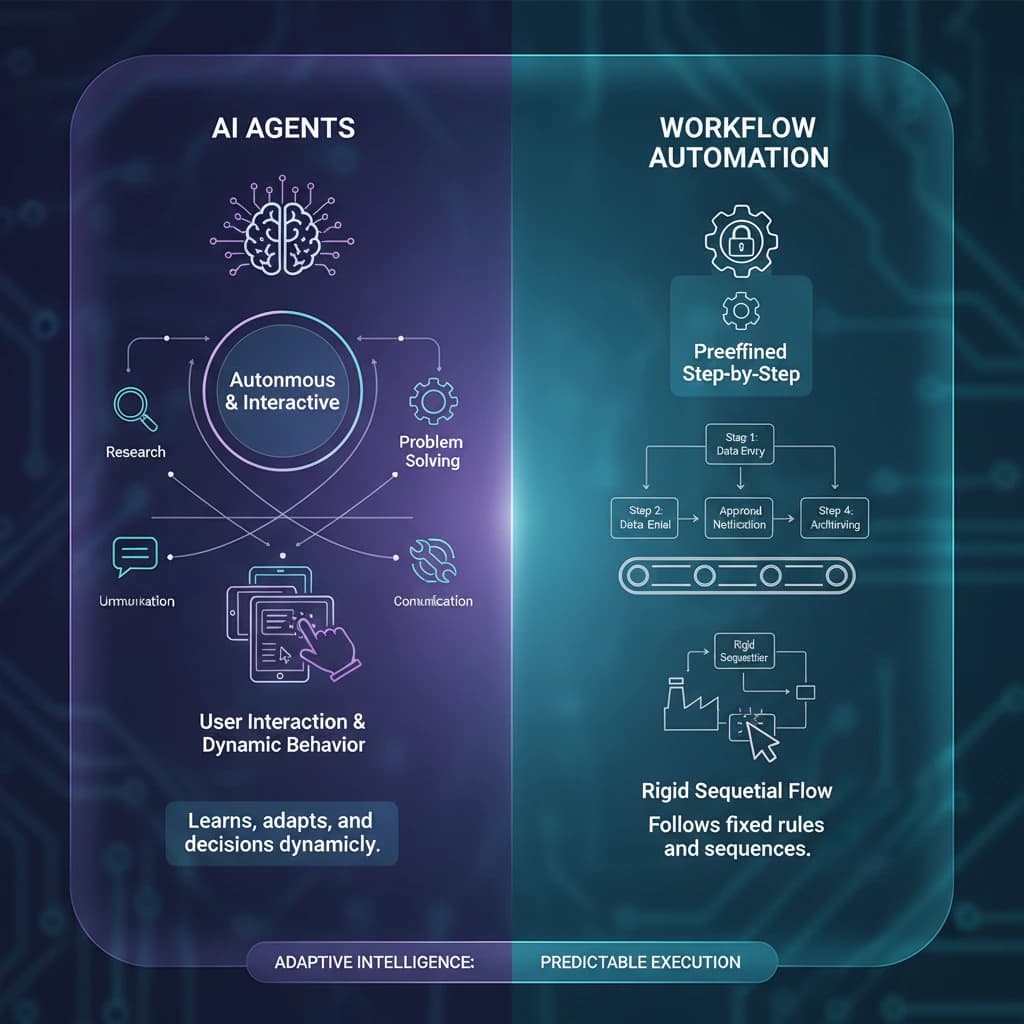
RPA automates through the UI layer (screen scraping, mimicking clicks). iPaaS automates through APIs (integrations, triggers, actions). AI agents automate through intent and judgment (read context, decide the next action, execute via APIs or UIs). Each has its place; the 2026 trend is layering agents on top of existing RPA and iPaaS investment rather than ripping and replacing. For the personal / knowledge-worker flavor of this, see our personal assistant page.
How often is this page updated?
Monthly. The "Last updated" date at the top reflects the most recent refresh. For breaking news between updates, follow the Arahi AI blog or subscribe to our newsletter. You can also browse the full connect integration library to see what's new on the Arahi side between posts.
Where can I find more automation news and analysis?
Gartner, Forrester, and IDC publish the most rigorous quarterly automation market analysis. For daily coverage: TechCrunch, The Register, and The Information. For community commentary: r/automation and the n8n community forum. For product-launch news across integrations, the Arahi AI blog maintains category-specific roundups. Start from our home page for the full content map.
Stay Updated
We refresh this page on the 15th of every month. The next scheduled update is May 15, 2026, covering news from mid-April through mid-May. If you'd rather get the same roundup in your inbox — plus occasional mid-month breaking-news briefs — subscribe to the Arahi AI newsletter.
Beyond this page, the Arahi AI blog maintains category-specific roundups for enterprise, healthcare, finance, and marketing automation. If there's a workflow-automation topic you'd like us to cover, the best way to request it is through the newsletter reply address — we read every response and queue requests for future posts.
Get automation news in your inbox
Monthly roundups of workflow automation trends, product launches, and analysis — written by the Arahi AI team.
Subscribe