

This article covers AI developments from December 2025. For the latest, see our AI agents news hub.
The Two Paradigms of Agentic AI: A Comprehensive Framework
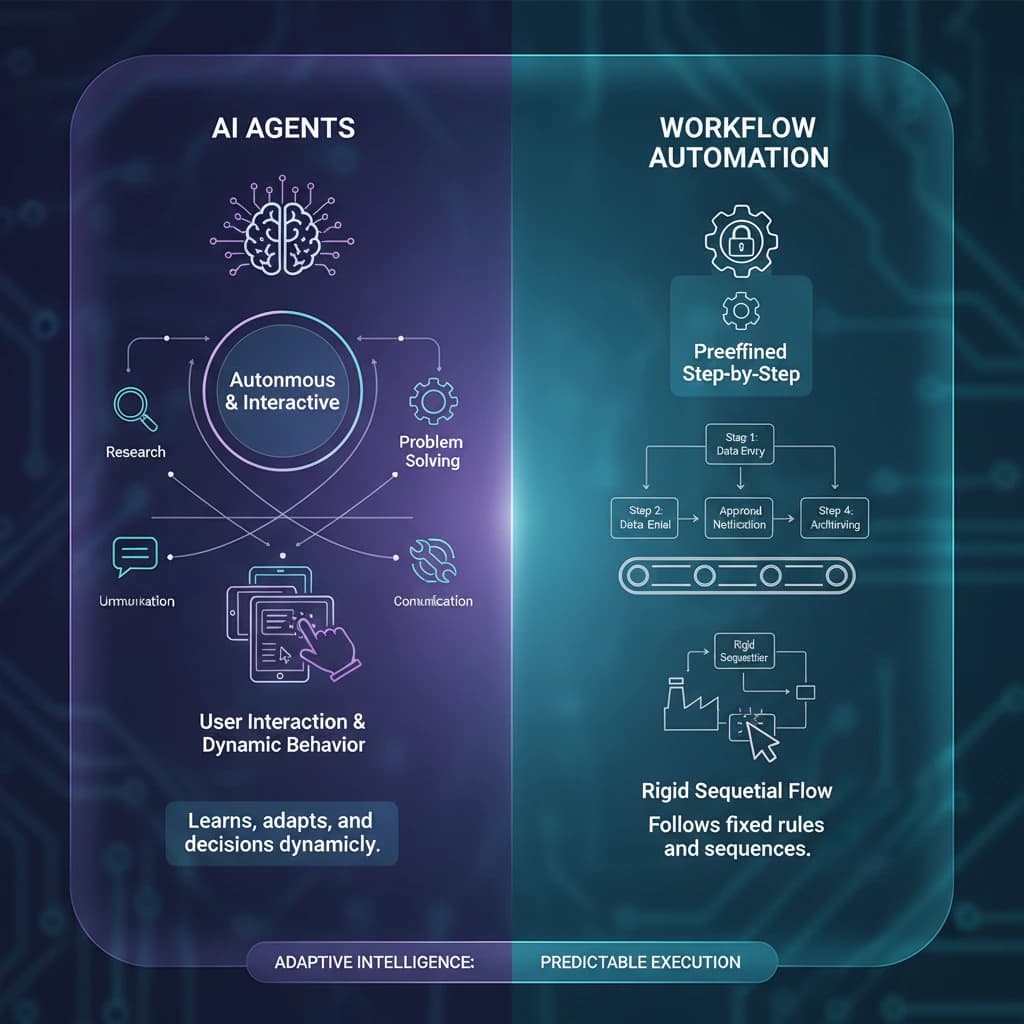
A groundbreaking new report provides essential reading for developers: a comprehensive categorization of agentic AI into symbolic (planning-based) and neural (prompt-driven) paradigms. This complements broader AGI work like DeepMind's collective intelligence networks and the evolving operational stack for AI agents.
The Symbolic Paradigm
Planning-Based Agents
Core Characteristics:
- Explicit goal representations
- Formal planning algorithms
- Rule-based decision-making
- Deterministic behavior
Key Technologies:
- PDDL (Planning Domain Definition Language)
- Hierarchical Task Networks (HTN)
- STRIPS planners
- Automated theorem proving
Strengths:
- Interpretable decisions
- Provable correctness
- Predictable behavior
- Efficient for structured problems
Weaknesses:
- Requires formal domain models
- Brittle in undefined situations
- Manual knowledge engineering
- Limited adaptability
The Neural Paradigm
Prompt-Driven Agents
Core Characteristics:
- Learned behaviors from data
- Natural language interaction
- Adaptive responses
- Probabilistic decisions
Key Technologies:
- Large Language Models (LLMs)
- Retrieval-Augmented Generation (RAG)
- Fine-tuning and RLHF
- Prompt engineering
Strengths:
- Handles ambiguity well
- Natural language interface
- Learns from examples
- Flexible and adaptive
Weaknesses:
- Unpredictable edge cases
- Hallucination risks
- Difficult to verify
- Resource-intensive
Hybrid Approaches: Best of Both Worlds
Symbolic-Neural Integration:
- Neural Planning: LLMs generate plans, symbolic systems execute
- Guided Generation: Symbolic constraints on neural outputs
- Tool-Using Agents: LLMs select, symbolic tools execute
- Hierarchical Systems: High-level neural, low-level symbolic
Example Architecture:
User Request → LLM (understanding + high-level plan)
           ↓
   Symbolic Planner (detailed execution plan)
           ↓
   Tool Executors (deterministic actions)
           ↓
   LLM (result synthesis + user communication)
Application Patterns
Symbolic Works Best For:
- Manufacturing automation
- Logistics optimization
- Safety-critical systems
- Regulated industries
- Formal verification needs
Neural Works Best For:
- Customer service
- Content generation
- Research assistance
- Creative tasks
- Unstructured problems
Hybrid Excels At:
- Complex business workflows
- Multi-step problem-solving
- Human-AI collaboration
- Adaptive automation
- Real-world deployment
Future Directions
The report identifies key research areas:
- Unified Frameworks: Single systems combining both paradigms
- Automatic Architecture Selection: AI choosing its own approach
- Explainable Neural Agents: Making LLM decisions interpretable
- Scalable Symbolic Systems: Handling real-world complexity
- Meta-Learning: Agents that improve their own architecture
Design Decision Tree
Choosing Your Architecture:
Need formal verification? → Symbolic Handling natural language? → Neural Safety-critical operations? → Symbolic Ambiguous requirements? → Neural Complex multi-step tasks? → Hybrid Rapid prototyping? → Neural Long-term reliability? → Symbolic/Hybrid
Implementation Frameworks
From Architecture to Action
Build production-ready AI agents without wrestling with infrastructure
Try the no-code approachSymbolic:
- Planning.domains
- pyperplan
- Fast Downward
- PDDL Studio
Neural:
- LangChain
- AutoGPT
- BabyAGI
- AgentNEO
Hybrid:
- Semantic Kernel
- LangGraph
- Haystack
- Custom integrations
The Path Forward
The future isn't one paradigm dominating—it's intelligent combination. Successful AI agents will:
- Use symbolic planning for reliability
- Use neural flexibility for adaptation
- Combine strengths while mitigating weaknesses
- Adapt architecture to specific use cases
This report is essential reading for anyone building next-generation AI agents.
Build sophisticated hybrid agents with AgentNEO at Arahi AI
Related: AGI Collective Intelligence Networks · Operational Stack Evolution for AI Agents · AI Agent Governance: A Resilience Mandate · Build AI Agents Without Code