

A practical guide to GPT-5's capabilities, pricing, and how businesses can build AI agents without code. Originally published December 2025, updated April 2026.
Quick Summary
- GPT-5 launched on August 7, 2025, combining advanced reasoning, multimodal input, and task execution in one unified model
- The model automatically routes between fast responses and deep reasoning—no manual switching required
- Hallucinations dropped roughly 45% compared to GPT-4o
- Three variants available: gpt-5 (deep reasoning), gpt-5-mini (balanced), and gpt-5-nano (ultra-fast)
- Context window expanded to 400,000 tokens via API
- You don't need to code to build GPT-5 powered agents—platforms like Deskferry let you connect to 1,500+ apps and automate workflows visually
What Actually Changed with GPT-5?
If you've been following OpenAI's releases over the past year, you've seen a parade of incremental improvements: GPT-4o made things faster, o1 improved reasoning, o3 pushed those capabilities further. GPT-5 pulls it all together.
On August 7, 2025, OpenAI released what they'd been building toward: a single model that handles conversation, deep reasoning, and multi-step execution without requiring you to pick between specialized variants. The model figures out what kind of thinking your query needs and adapts accordingly.
Since launch, GPT-5 has become the default model across ChatGPT and the API, and businesses have had months to integrate it into production workflows. The verdict: it delivers on the core promises, though real-world performance varies by use case.
For businesses trying to automate workflows, this matters. Previous models required workarounds—switching between different model endpoints, building complex routing logic, or just accepting that certain tasks weren't worth the setup cost. GPT-5 removes most of that friction. If you're weighing GPT-5 against other models for daily work, our ChatGPT alternatives roundup covers the trade-offs.
The Three GPT-5 Variants (And When to Use Each)
OpenAI didn't release just one model. They launched a family:
| Variant | Best For | Context Window | Knowledge Cutoff |
|---|---|---|---|
| gpt-5 | Complex reasoning, multi-step workflows, analysis | 400K tokens | Sept 30, 2024 |
| gpt-5-mini | Balanced speed and reasoning, everyday tasks | 400K tokens | May 30, 2024 |
| gpt-5-nano | Real-time responses, high-volume automation | 400K tokens | May 30, 2024 |
The practical breakdown:
gpt-5: Use this when accuracy matters more than speed. Legal document review, financial analysis, complex customer inquiries that need careful reasoning.
gpt-5-mini: Your workhorse. Fast enough for real-time chat, smart enough for most business tasks. This is where most automation workflows should start.
gpt-5-nano: When you need instant responses at scale. Think real-time routing, quick classifications, or any scenario where milliseconds matter.
What GPT-5 Actually Does Better
Let's cut through the marketing language and look at what's meaningfully different:
Reasoning That Adapts Automatically
GPT-5 includes a built-in routing system. Ask a simple question, get a fast answer. Ask something that requires working through multiple steps, and the model shifts into chain-of-thought reasoning without you having to prompt it.
This matters for automation. Previously, building an AI agent that could handle both quick FAQs and complex troubleshooting meant either over-engineering your prompts or building separate flows. Now the model handles that routing itself.
Actually Useful Context Windows
400,000 tokens through the API. That's roughly 300,000 words—enough to hold entire contracts, lengthy support tickets with full conversation history, or comprehensive product documentation.
More importantly, GPT-5 maintains coherence across that context better than its predecessors. The model actually uses information from earlier in the conversation instead of gradually "forgetting" it.
Fewer Hallucinations
OpenAI reports roughly 45% fewer hallucinations compared to GPT-4o. In practice, this means less time double-checking outputs and more confidence in automated workflows handling edge cases correctly. Our deep dive on how accurate ChatGPT really is puts these numbers in context.
Better Multilingual Performance
If your business operates across languages, GPT-5's improvements here are substantial. Voice interactions in Spanish, Hindi, Japanese, and Arabic are notably smoother. Translation accuracy improved across the board.
What GPT-5 Costs
API Pricing (per 1M tokens)
| Model | Input Cost | Output Cost |
|---|---|---|
| gpt-5 | $1.25 | $10.00 |
| gpt-5-mini | $0.05 | $0.40 |
| gpt-5-nano | $0.25 | $2.00 |
| gpt-4o (reference) | $2.50 | $10.00 |
The takeaway: gpt-5-mini is remarkably cheap for what it delivers. At $0.05 per million input tokens, most business automation use cases cost pennies per interaction.
ChatGPT Subscription Tiers
- Free: GPT-5 with standard capabilities and daily limits
- Plus: Higher limits, better reasoning performance
- Pro: Access to GPT-5's full "thinking" mode, extended context, priority access
Build GPT-5 Powered AI Agents
Connect 1,500+ apps and automate workflows with no code required
Start buildingHow to Build AI Agents with GPT-5 (Without Writing Code)
Here's where this gets practical for businesses.
You don't need a development team to use GPT-5. No-code platforms let you build AI agents that use these capabilities and connect them directly to your existing tools. Not sure which AI platform fits your workflow? See our head-to-head comparison of the best personal AI assistants in 2026.
Building a GPT-5 Agent with Deskferry
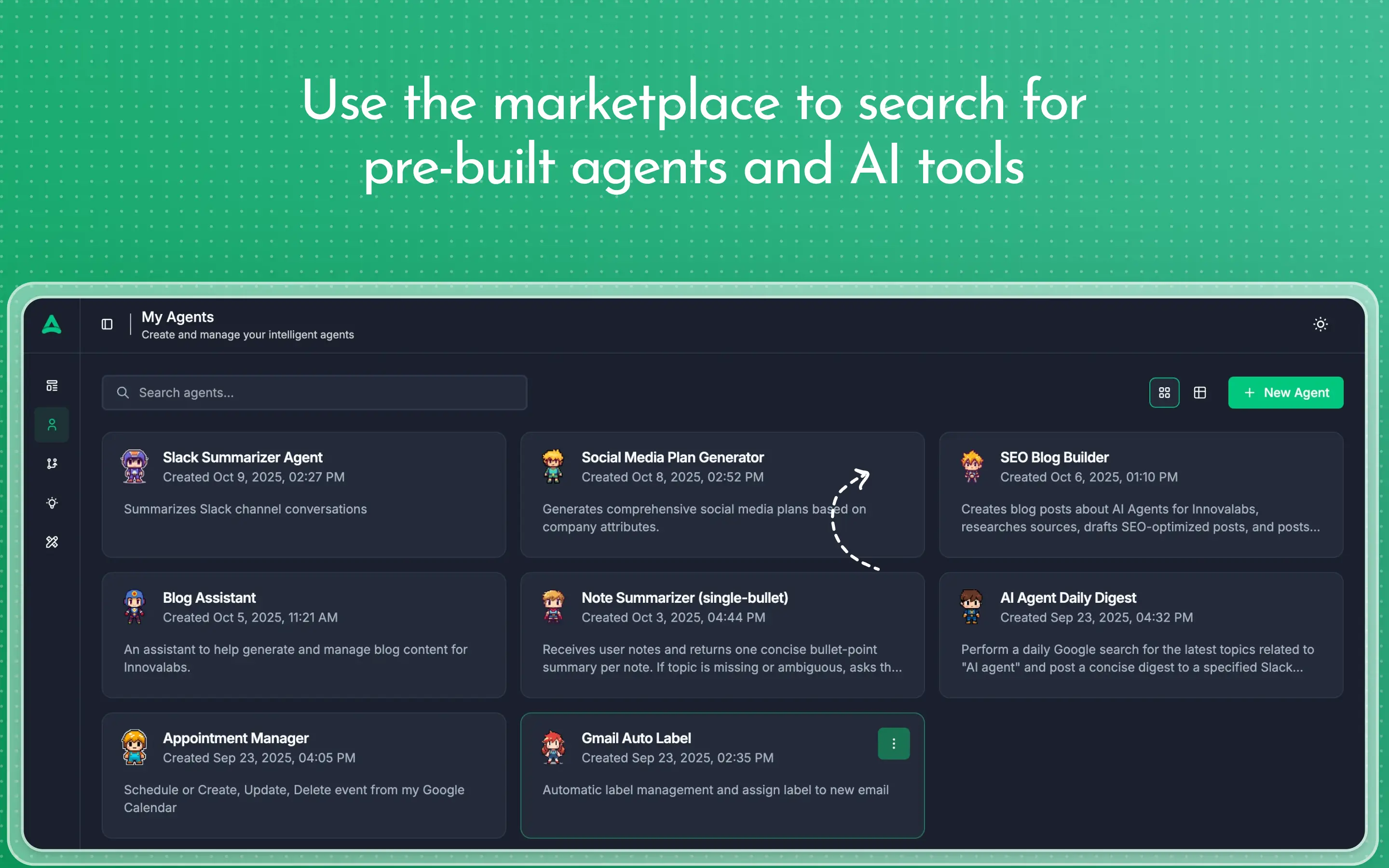
Deskferry connects to over 1,500 applications—CRMs, email platforms, databases, spreadsheets, project management tools, you name it. Here's how to build an AI agent powered by GPT-5:
Step 1: Define what your agent should do
Get specific. "Handle customer inquiries" is too vague. "Answer questions about order status, process refund requests, and escalate complaints to the support team" gives you something you can actually build.
Start with one clear function and expand from there.
Step 2: Create your agent and set its instructions
In Deskferry's agent builder, describe your agent's role in plain language:
"You are a customer support agent for an e-commerce store. Help customers track orders by looking up their order number in our system. If they request a refund for orders under $50, process it automatically. For larger amounts or complaints, create a support ticket and notify the team."
GPT-5 understands nuanced instructions. The clearer you are about edge cases and decision logic, the better it performs.
Step 3: Connect your knowledge base
Upload the documents, FAQs, and product information your agent needs to reference. GPT-5's expanded context window means you can include comprehensive documentation without worrying about the model losing track of important details.
Good sources to include:
- Product catalogs and pricing
- Return/refund policies
- Common troubleshooting guides
- Company information and values
Step 4: Connect your integrations
This is where no-code platforms save you weeks of development time. With Deskferry, you can connect:
- Your CRM (HubSpot, Salesforce, Pipedrive)
- Email platforms (Gmail, Outlook)
- E-commerce platforms (Shopify, WooCommerce)
- Databases and spreadsheets
- Slack, Discord, or Teams for internal notifications
- Thousands more
Your agent can read from and write to these systems directly—no API coding required.
Step 5: Deploy across channels
Once your agent is working, deploy it where your customers are:
- Website chat widget
- Facebook Messenger
- Slack
- Custom channels via API
GPT-5 vs. GPT-4o: What's Actually Different?
| Capability | GPT-4o | GPT-5 |
|---|---|---|
| Context window | ~128K tokens | Up to 400K tokens |
| Hallucination rate | Baseline | ~45% fewer |
| Output efficiency | Baseline | 50-80% fewer tokens for same results |
| Multimodal handling | Text/vision/voice | Smoother transitions, better vision |
| Model switching | Manual | Automatic routing |
The biggest practical difference? GPT-5 eliminates the "which model should I use?" problem. The built-in routing means you don't need to architect complex systems to get good performance across different task types.
The User Reaction (It's Complicated)
GPT-5's launch wasn't all celebration. OpenAI's decision to make it the default model and initially remove access to GPT-4o sparked genuine backlash from users who'd developed workflows around the older model's behavior.
Some users described genuine attachment to how GPT-4o communicated. Others had fine-tuned their prompts for specific GPT-4o quirks and found their workflows broken.
OpenAI responded by restoring GPT-4o access for Plus subscribers, but the incident highlighted a real tension: as models improve, they also change in ways that can break existing implementations.
The lesson for businesses: build your AI workflows with flexibility in mind. Use platforms that abstract away the model layer so you can adapt as the underlying technology evolves.
What GPT-5 Means for Business Automation
Let's be direct about what's changed and what hasn't.
What's genuinely new:
- Complex, multi-step reasoning is now practical for automation
- Longer context means better handling of nuanced, document-heavy workflows
- Reduced hallucinations make autonomous agents more trustworthy
- The cost curve keeps dropping—GPT-5-mini makes sophisticated AI accessible to smaller businesses
What still requires human oversight:
- High-stakes decisions still need review
- Customer-facing interactions benefit from escalation paths
- Training and prompt refinement remain necessary for best results
The opportunity: Businesses that figure out how to integrate GPT-5 into their workflows now will have a significant head start. Not because the technology is magic—it isn't—but because the combination of capability and accessibility has finally crossed a threshold where automation makes sense for a much wider range of use cases.
Ready to Build?
GPT-5 is live and accessible. The question isn't whether AI can help automate your business workflows—it's whether you'll build those systems yourself or let competitors figure it out first.
Deskferry gives you GPT-5's capabilities without the complexity. Connect your tools, describe what you want your agent to do, and deploy across any channel—all without writing code.
Start building your first AI agent →
Related: How Accurate is ChatGPT? · ChatGPT Alternatives · No-Code AI Agent Builder Guide · Conversational AI Guide 2026 · AI Agents News
Last updated: April 2026